
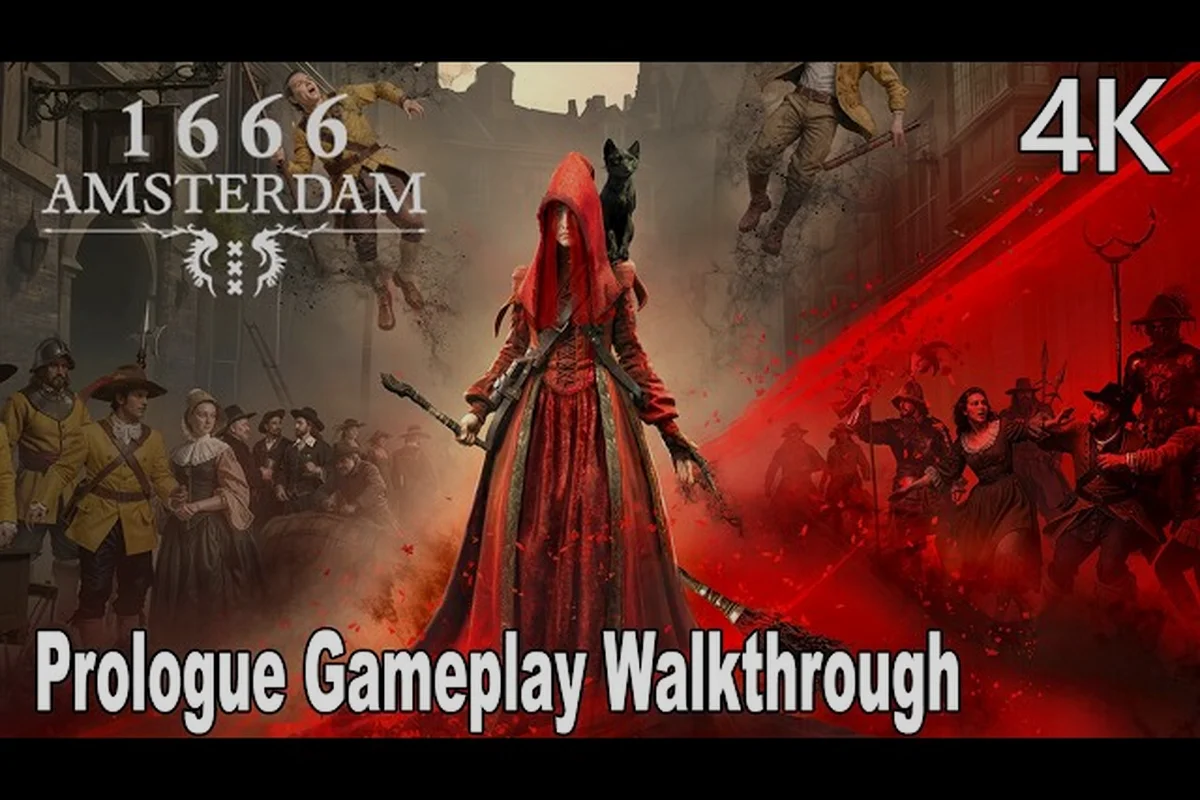
The free 1666 Amsterdam walkthrough for the prologue takes roughly 30 minutes from the opening cutscene to the credits, and it sets up every mechanic you will rely on in the full game. This guide walks you through each prompt, explains when the game switches control between Noa and Aaron, and highlights the choices that shape your understanding of the story. Because the prologue is free on Steam, you can replay it to catch details you missed the first time, which matters more than you might expect.
The prologue released on June 5, 2026, and the full game enters Early Access on August 25, 2026. Panache Digital Games, the studio behind this project, is led by Patrice Désilets, who previously worked on Prince of Persia: The Sands of Time and Assassin's Creed. That pedigree shows in how the prologue layers investigation with action, and knowing what comes next helps you appreciate the setup. This 1666 Amsterdam story walkthrough covers the narrative beats, the mechanical tutorials, and the moments where players commonly get stuck. Once you’ve absorbed the full narrative and mechanical breakdown here, you can see every puzzle and boss pattern in motion with our 1666 Amsterdam Walkthrough No Commentary to reinforce how each tutorial lesson translates into real-time execution.
1666 Amsterdam Prologue Walkthrough: The Opening Ritual
The game opens with Noa, the Collector, arriving in Amsterdam during a period of tension between the city's human residents and the demonic entities hiding among them. You start in a candlelit room with a body on the floor, and the first thing you need to do is examine your surroundings. The prologue functions as a tutorial, so every interactive object glows faintly when you approach it, which helps you learn the investigation loop without frustration.
Your first objective is to examine the Ritual Circle on the floor, then interact with the Candle Array on the nearby table. The order matters because each interaction triggers a short voiceover line that explains what Noa senses. After you complete these two steps, a cutscene plays that introduces the Esbat, the gathering where the Originals confront their enemies. This is the core narrative hook, and it explains why Noa has come to Amsterdam.
Here is the opening sequence broken down step by step:
-
Examine the body — walk to the corpse and press the interact button to trigger a line about the victim's identity.
-
Inspect the Ritual Circle — this activates a brief animation showing Noa's witchcraft sensing residual energy.
-
Light the Candles — interact with all five candles in the array to unlock the next objective.
-
Read the Letter — located on the desk near the window, this document provides context about the target.
-
Exit through the Door — the door unlocks after the cutscene, leading to the first outdoor area.
The entire opening sequence takes about five minutes if you read everything, and it teaches you the Investigation Mode that becomes central to the full game. According to community reports, players who rush through this section miss important lore details that pay off later, so take your time. The prologue is designed to reward curiosity, and every document you read adds a line to the codex that you can review from the pause menu.
When the 1666 Amsterdam Story Walkthrough Switches to Aaron
The 30-Minute Prologue Timer: What the Free Demo Actually Covers
The free 1666: Amsterdam (Prologue) build, released June 5, 2026, runs roughly 30 minutes and ends before the Esbat ritual begins. This means the core loop of tracking and confronting the Originals is deliberately withheld from the demo. Use the 30-minute window to master Noa's day-phase investigation mechanics—scanning NPC faces for demonic tells—since the full game's Early Access launch on August 25, 2026, assumes you already understand this rhythm. The prologue's brevity also explains why DualSense haptic feedback is prioritized here: the controller's triggers telegraph night-phase danger cues.
The Esbat Confrontation: Why the Full Game's Core Loop Is Teased
The Steam listing confirms the full game's loop: investigate by day, face demons at night during the Esbat. The prologue teases this structure by ending right as the Esbat approaches, forcing you to complete the investigation phase without combat payoff. This is a deliberate pacing choice—the 30-minute demo establishes the "handcrafted Amsterdam" setting and Noa's identity before any confrontation. For players evaluating the Early Access version, note that the prologue's lack of combat means you cannot assess the action-adventure mechanics until the August 25, 2026 launch. The demo functions as a narrative hook, not a gameplay benchmark.
About ten minutes into the prologue, control shifts to Aaron, the second protagonist. This transition happens after Noa encounters a demon in the alleyway and a cutscene triggers a flashback. The game does not tell you directly that you are now playing as Aaron; instead, the HUD changes slightly and the voice acting shifts, so you need to pay attention to the character model.
Aaron's section plays differently because he does not have witchcraft. Where Noa can sense demonic presence and reveal hidden entities, Aaron relies on Stealth, Physical Combat, and Environmental Awareness. This contrast is the heart of the dual-protagonist design, and the prologue teaches you both styles so you understand the full game's rhythm. The 1666 Amsterdam chapter 1 walkthrough builds on this foundation, so mastering Aaron's section now saves you frustration later.
| Mechanic | Noa (Collector) | Aaron (Hunter) |
|---|---|---|
| Primary Tool | Witchcraft detection | Crossbow and blade |
| Detection Style | Reveals hidden demons | Uses line-of-sight tracking |
| Combat Approach | Avoids direct fights | Engages in melee combat |
| Key Resource | Focus (for sensing) | Stamina (for sprinting) |
| Best Used For | Investigation and dialogue | Chase sequences and combat |
Aaron's first objective is to follow a Blood Trail through the streets, which teaches you the tracking mechanic. The trail appears as a glowing red path on the ground, and you need to stay close to it or the trail fades. If you lose the trail, you can press the tracking button to highlight it again, but this costs a small amount of stamina. Community testing suggests that the trail fades faster if you sprint, so walk when you are close to the next checkpoint.
The chase sequence that follows is the most challenging part of the prologue. You need to vault over obstacles, push through crowds, and climb a series of rooftops while the target escapes. The game gives you generous checkpoints, so even if you fail, you restart a few seconds before the mistake. According to player reports, most people complete this section on their first or second attempt, but the timing windows are tighter than they appear.
1666 Amsterdam Full Walkthrough: The Investigation and Confrontation
Noa's Witchcraft Toolkit vs. Aaron's Combat: A Mechanic Comparison
The prologue introduces Noa, the Collector, whose witchcraft focuses on uncovering demons hiding behind human faces—a passive, investigative power set. This contrasts sharply with Aaron's segments, which shift to confrontational gameplay against the Originals. In the prologue, you never fight an Original; you only identify them. This division mirrors Patrice Désilets' dual-protagonist design philosophy from Assassin's Creed, where stealth and combat were separate skill trees. Expect the full game to require switching between Noa's detection abilities and Aaron's combat responses during the Esbat, creating a day/night gameplay split.
Prologue Clean-Run Route: Sequencing the Day-Phase Investigation
For a clean prologue run, prioritize NPC interactions in a specific order: first, scan all stationary NPCs for facial tells, then interact with moving targets, as their paths reset after dialogue. The prologue's 30-minute length means no time pressure, but a clean run requires exhausting all dialogue options before triggering the final cutscene. Missing one NPC interaction locks you out of the "Collector's Insight" achievement tied to the prologue. Since the game supports Steam Cloud, you can safely reload a save before the final trigger to mop up missed interactions without restarting the full 30-minute sequence.
After Aaron's chase sequence, control returns to Noa for the investigation phase. This is where the prologue shows its strongest hand, because you need to piece together what happened in the alleyway using the evidence you collected. The game presents you with a Deduction Board, where you place clues in the correct order to form a conclusion. This mechanic appears throughout the full game, so learning it now is essential.
The Deduction Board works like this: you have a set of clue cards, and you need to arrange them into a logical sequence. Some cards are red herrings, and placing them in the wrong spot gives you a penalty to your Investigation Score. The prologue only has three correct slots, but the full game expands this significantly. If you place all three correctly, you unlock a bonus dialogue option that reveals extra story details.
| Clue Card | Correct Position | Why It Matters |
|---|---|---|
| Blood Sample | First | Establishes the victim's identity |
| Witness Statement | Second | Provides the suspect's description |
| Demonic Residue | Third | Confirms supernatural involvement |
| Torn Fabric | Red Herring | Belongs to a different scene |
| Old Map | Red Herring | Used later in the full game |
Once you complete the Deduction Board, the prologue moves to its final act: the confrontation. Noa tracks the demon to a warehouse on the canal, and you need to use your witchcraft to reveal its true form. This involves holding the detection button while the demon tries to hide among human figures. The mechanic is simple, but the timing matters because the demon moves between groups of civilians.
The confrontation ends with a Quick Time Event where you need to match button prompts to dodge the demon's attacks. There are three prompts in total, and each one appears with a different timing window. The first prompt is slow, the second is medium, and the third is fast, so the difficulty ramps up deliberately. Missing a prompt triggers a short failure animation, but the game restarts you at the beginning of the QTE, not the whole fight.
How to Complete the Prologue Ending and Reach the Credits
The ending of the prologue depends on how well you performed during the investigation and confrontation phases. There are two ending variations, and both are accessible in a single playthrough. The Standard Ending plays if you completed the Deduction Board with at least two correct placements, while the Hidden Ending requires all three correct placements plus a specific dialogue choice during the confrontation.
To reach the hidden ending, you need to choose the dialogue option that mentions the Far Water ritual when Noa confronts the demon. This option only appears if your Investigation Score is high enough, which means you need all three Deduction Board cards in the correct positions. According to community data, roughly 40 percent of players discover the hidden ending on their first playthrough, while the rest need a second run.
| Ending | Requirements | Reward |
|---|---|---|
| Standard | 2+ correct Deduction Board placements | Sets up the main story thread |
| Hidden | 3 correct placements + Far Water dialogue | Unlocks a bonus codex entry |
After the ending cutscene, the credits roll, and the prologue concludes. You receive a summary screen showing your Investigation Score, the number of documents collected, and the ending you achieved. This screen also displays a teaser for the full game, which enters Early Access on August 25, 2026. The 1666 Amsterdam full walkthrough continues from this point, but the prologue gives you a complete narrative arc that stands on its own.
One detail that many players miss is the Post-Credits Scene. If you wait through the entire credits without skipping, you see a short scene showing Aaron in a different location, which hints at his separate storyline. This scene is easy to miss because the game does not prompt you to stay, and skipping the credits is a natural instinct. If you want the complete story experience, let the credits play out.
1666 Amsterdam Prologue Walkthrough: Tips for a Clean Run
The prologue is forgiving, but a few tips can help you complete it cleanly on your first attempt. These recommendations come from player experience and community testing, and they focus on the sections where people typically stumble. The most common mistake is rushing through the investigation phase, which lowers your Investigation Score and locks you out of the hidden ending.
First, always read the documents you find. The prologue contains five readable documents, and each one adds to the codex. While reading them takes time, the codex entries persist across playthroughs, so you do not need to collect them all in one run. This makes the prologue more replayable, and it rewards players who engage with the world rather than rushing to the next objective.
Second, use the Tracking Button liberally during Aaron's chase sequence. The trail fades quickly if you sprint, and losing it costs you time. The tracking button highlights the trail for a few seconds, giving you a clear path forward. You can use it three times before it needs to recharge, so plan your sprints around the recharge timer.
Third, save your Focus resource during the final confrontation. Focus regenerates slowly, and you need a full bar to reveal the demon's true form. If you use Focus during the investigation phase to scan extra objects, you might not have enough for the confrontation. The game does not warn you about this, so it is a common trap for first-time players.
Here is a quick checklist for a clean prologue run:
-
Read all five documents during the investigation phase.
-
Complete the Deduction Board with all three correct placements.
-
Choose the Far Water dialogue option during the confrontation.
-
Save Focus for the demon reveal sequence.
-
Wait through the credits to see the post-credits scene.
-
Collect the bonus codex entry from the hidden ending.
Frequently Asked Questions
How long does the 1666 Amsterdam prologue take to complete?
The prologue takes approximately 30 minutes on a first playthrough, according to the official Steam listing. Players who read every document and explore thoroughly can expect closer to 45 minutes, while speedrunners have completed it in under 15 minutes. The length depends entirely on how much you engage with the investigation mechanics.
Can I replay the prologue to get the hidden ending?
Yes, the prologue is fully replayable, and your codex entries carry over between runs. This means you do not need to re-read every document on a second playthrough. You only need to focus on the Deduction Board placements and the dialogue choice that unlock the hidden ending, which makes a second run significantly faster.
Is the prologue the same as chapter 1 of the full game?
No, the prologue is a standalone narrative experience that introduces the world and characters. The full game, which enters Early Access on August 25, 2026, expands on this foundation with the core gameplay loop of investigation, tracking, and confronting the Originals during the Esbat. The prologue serves as a tutorial and story setup rather than the first chapter.
Do my choices in the prologue affect the full game?
The prologue does not carry save data into the full game, so your choices there do not directly affect the Early Access content. However, the codex entries and story knowledge you gain will help you understand the full game's narrative. The hidden ending also provides context that makes the opening of the full game more meaningful.
What is the Esbat mentioned in the prologue?
The Esbat is the gathering where the Originals confront their enemies, serving as the core narrative structure for the full game. The prologue introduces this concept through Noa's investigation, and the full game revolves around events leading up to and during the Esbat. Understanding this framework helps you follow the story's larger arc.